In 987, the emissaries of Prince Vladimir of Kiev finally arrived in Constantinople, where they were taken to Hagia Sophia (Ἁγία Σοφία), the cathedral church of the capital. Their report was this: “We knew not whether we were in heaven or on earth. For on earth there is no such splendor or such beauty, and we are at a loss how to describe it. We know only that God dwells there among men, and their service is fairer than the ceremonies of other nations. For we cannot forget that beauty.”
The purpose of Orthodox liturgical music is to uplift the prayers of Orthodox faithful and to have a worship experience that transports us to the Kingdom of Heaven. In Hagia Sophia during the height of the Byzantine Empire is the origin and purest form of Byzantine Chant. From ancient Byzantium, the chant has developed significantly, though it still shares the same roots.
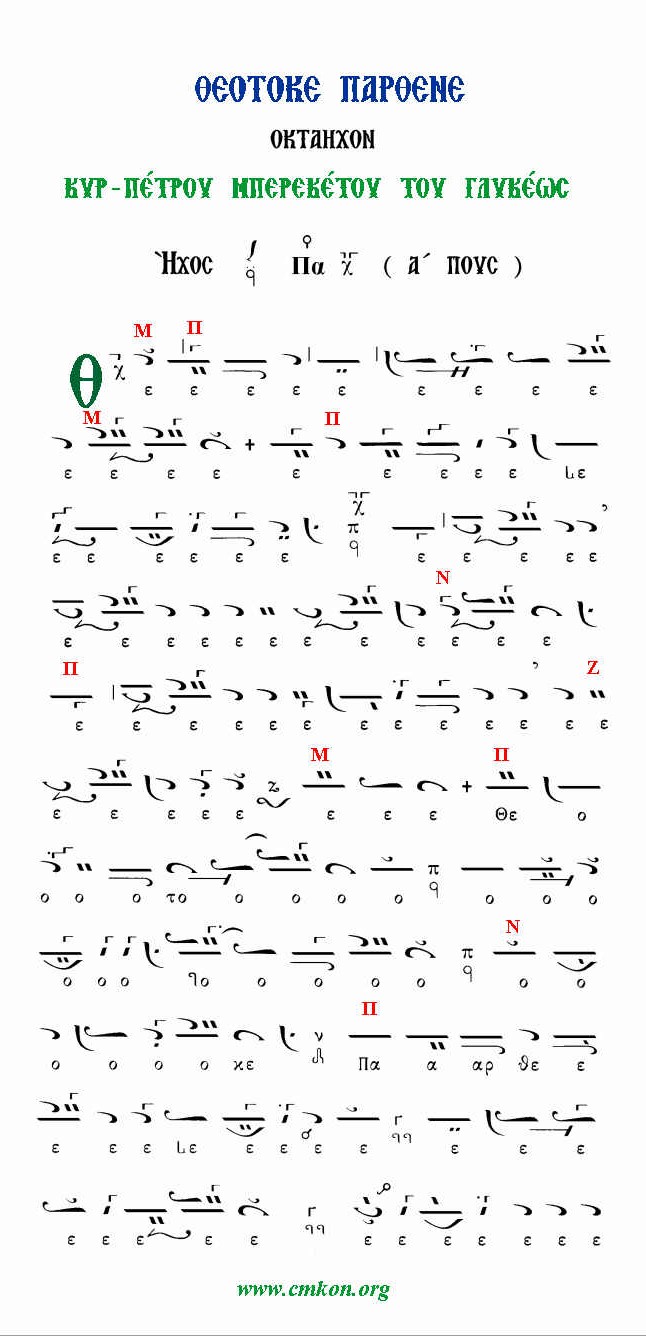
Byzantine Chant even has its own notation and style of sheet music! Unlike staff notation that we all learned in grade school, Byzantine notation is relative, meaning the sheet music gives the chanter a starting pitch and “instructions” on how many pitches to ascend or descend from the homebase note. For example in western music terms, if the hymn starts on C and the next note is E, the Byzantine music would have a symbol telling the chanter to ascend two notes.
Have you ever heard someone say “first mode” or “that’s in fourth mode?” That is because Byzantine Chant is made of a system of 8 modes, each one having a different sound and melodic movements. Having a variety of modes is used to communicate different emotions in the hymnology. Some modes communicate a triumphant sound, while some communicate a somber, repentant tone. Ultimately, the purpose of all of this is to glorify Christ and worship Him with the best that our voices can offer! Chanting the divine services at St. Mary’s is a true joy and I am thankful to be with you all!
In Christ, Joseph Karos,
Protopsaltis, St Mary’s GOC Minneapolis

0 Comments