New: Parish Programs Page / Educ Online Class / Area Rehearsal #4, 7PM Mon, Sept 14, Holy Apostles GOC, Westchester, IL

Church Organ

Aug 8, 2024 | Uncategorized | 0 comments

The Organ – ὄργανον (órganon). It’s Greek!

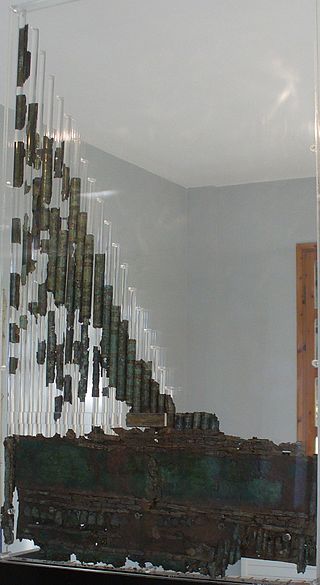
The Greek engineer Ctesibius of Alexandria is credited with inventing the organ in the 3rd century BC. He devised an instrument called the hydraulis, which delivered a wind supply maintained through water pressure to a set of pipes. The pumps and water regulators of the hydraulis were replaced by an inflated leather bag in the 2nd century AD, and true bellows began to appear in the Eastern Roman Empire in the 6th or 7th century AD.

The 9th century Persian geographer Ibn Khurradadhbih (d. 913), in his lexicographical discussion of instruments, cited the urghun (organ) as one of the typical instruments of the Eastern Roman (Byzantine) Empire. The first Western European pipe organ with “great leaden pipes” was sent from Constantinople to the West by the Byzantine emperor Constantine V as a gift to Pepin the Short King of the Franks in 757.

Because organs are commonly found in churches and synagogues, the organ repertoire includes a large amount of sacred music, which is accompanimental (choral anthems, congregational hymns, liturgical elements, etc.) as well as solo in nature (chorale preludes, hymn versets designed for alternatim use, etc.).

[Text and photo from Wikipedia.org]

Written by

Related Posts

Arvo Pärt

If you know the music of Arvo Pärt, chances are you like it. A lot. In fact, chances are, you connect with it on a very deep level, perhaps a “spiritual” one. But love him or not, the fact is that Arvo Pärt is the most widely performed living composer in the world today. He is a big deal.

He is also an Orthodox Christian, who draws on texts from the Eastern and Western Christian traditions for most of his music.

So it would make sense that St. Vladimir’s Seminary, whose vocation rests in making theology and spirituality something real in people’s lives, would be interested in exploring the connections between the cultural phenomenon of Arvo Pärt and his Orthodox Christian roots. One of the seminary’s latest and most potent tag-lines is “Engaging the world with Orthodox Christianity.” The seminary’s Arvo Pärt Project fits perfectly with that.
Read More…
https://www.svots.edu/blog/arvo-part-project-why

read more

O Come, O Come, Emmanuel

"O come, O come, Emmanuel" (Latin: "Veni, veni, Emmanuel") is a Christian hymn for Advent, which is also often published in books of Christmas carols.[1][2][3] The text was originally written in Latin. It is a metrical paraphrase of the O Antiphons, a series of...

read more

Carol of the Bells

"Carol of the Bells" (also known as the "Ukrainian Bell Carol") is a choral miniature work originally composed by the Ukrainian composer Mykola Dmytrovych Leontovych. Throughout the composition, Leontovych used a four note motif as an ostinato which was taken from an...

read more

0 Comments

Submit a Comment

Your email address will not be published. Required fields are marked *